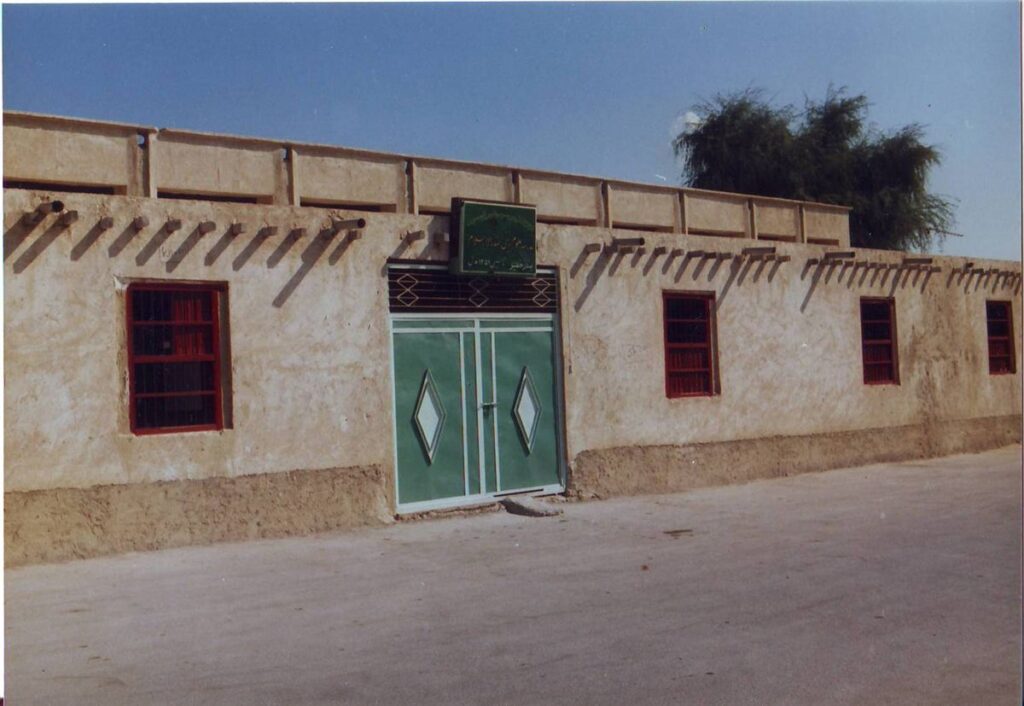
The first religious school in the region is the Mohammadiyeh School of Dezhgan, located 30 kilometers west of Bandar Khamir. It was built in 1278 AH by Haji Mohammad Khan Bastaki, the ruler of Dezhgan at the time, and for nearly eighty years it was run by the late Seyed Mohammad Alam Sadr al-Islam and his son, the late Seyed Abdolrahim Sadr al-Islam, who served the religious affairs of the people of the region. After the death of the late Seyed Abdolrahim the school closed, but its building, which has an interesting and unique style, has survived intact, and in recent years the Cultural Heritage Organization of Hormozgan Province has repaired and restored it to prevent its destruction.

Many students were trained at the Mohammadiyeh School; among the most famous was the late Sheikh Habib Farsi of “Hiru” — a village between Dezhgan and Lamzan — who for years was a great mufti and mujtahid, judge and teacher in Muscat and wrote many works. Another student of this school was the late Sheikh Abdolrahman Sheikh Mohammad Sheikh Zakariya, one of the scholars and notable figures of Qeshm Island. Another famous student was Sadr al-Islam's eldest son, the late Seyed Abdolrahim ibn Seyed Mohammad Alam Sadr al-Islam, who after his father's death ran the Mohammadiyeh Religious School of Dezhgan until the last moments of his life and served as the mufti for the region's religious matters.
Seyed Amir Sheikh Ghatali, the youngest son of the late Seyed Mohammad Alam Sadr al-Islam, founded a school called the Sadr al-Islam Religious School in Bandar Khamir in 1351 SH, to continue the Mohammadiyeh School of Dezhgan.
The school was run by the late Seyed Amir Sheikh Ghatali. Because of his advanced age, his son Seyed Abdolba'eth Ghatali — who had studied for years under the late Maulana Sheikh Mohammad Ali Khalidi (Sultan al-Ulama) — helped him run it. On Seyed Abdolba'eth Ghatali's initiative, in 1363 SH Sheikh Abdolaziz Qazizadeh, who held a master's degree in Sharia from Medina, was recruited to teach at the school, followed in 1364 by Sheikh Abdolkarim Mohammadi, Sheikh Omran Saleh and Seyed Abdolmonem Ghatali. In 1365 Sheikh Saleh Mohammadi and Haji Abdolrahman Malahi, and in 1366 Seyed Mohammad Shafi Qureshi and Haroun Shafiqi from the Talesh region, joined them, and the Sadr al-Islam School reached an ideal state in terms of teachers.
From 1369 SH, Seyed Abdoljalil Ghatali, another son of the late Seyed Amir Sheikh Ghatali, despite working in the Ministry of Education, took over the school's general management to help his father, and in 1374 after the death of the late Seyed Amir Sheikh Ghatali he practically entered the field of managing the school. Today, through his efforts and those of its dedicated staff, this institution has, after years, become a religious complex.
The late Seyed Mohammad Amir Ghatali also served this complex for nearly twenty years as a young and active member, and during his management of the brothers' section the school won top rankings among the Sunni schools of the south for many years.